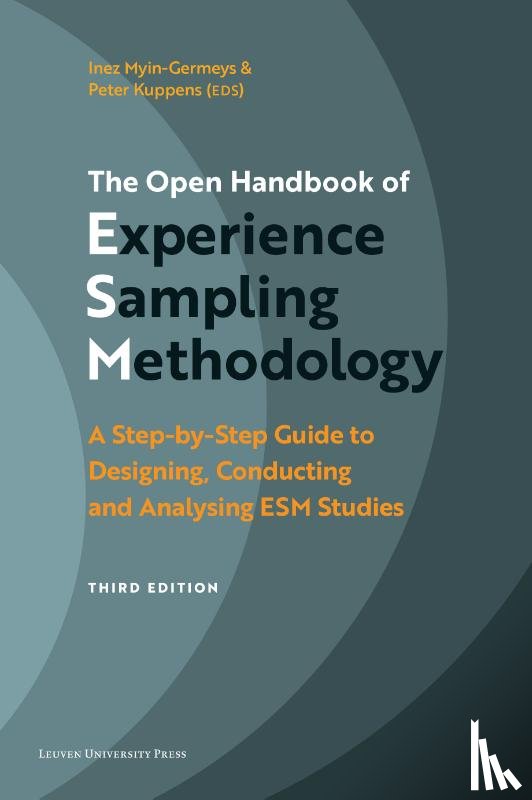
The Open Handbook of Experience Sampling Methodology
A Step-by-Step Guide to Designing, Conducting and Analysing ESM Studies
Omschrijving
Updated third edition covering every step of Experience Sampling Method research As obvious as it may sound, the essence of human experience — our thoughts, emotions, behaviours and social interactions — plays out in the course of everyday life.
Experience Sampling Methodology (ESM) is the gold standard for studying people’s experiences in their everyday environments. In this third edition of The Open Handbook, experts from the Center for Research on Experience Sampling and Ambulatory Methods Leuven (REAL) provide up-to-date, empirically based advice for designing, conducting and analysing ESM studies.
This comprehensive guide walks readers through every step of ESM research: from formulating research questions and optimally designing ESM studies and questionnaires, to addressing ethical considerations and practical issues such as power calculations, software choices and briefing/debriefing procedures. It also covers preprocessing and analysing intensive longitudinal data and explores future applications of ESM.
Each chapter of this third edition has been updated with the latest methodological developments and insights, and a new chapter on dyadic ESM research has been added. Ideal for both novice and expert researchers, this handbook is an invaluable resource for anyone embarking on ESM research. Chapter 1. Experience Sampling Methods: An Introduction
1.1 What are Experience Sampling Methods?
1.2 The scientific roots of ESM
1.3 Conclusion
Chapter 2. Research Questions That Can Be Answered with ESM Research
2.1 Research questions in observational ESM research
2.2 Research questions involving non-natural variation
Chapter 3. Designing an Experience Sampling Study
3.1 A selection of five ESM studies as examples
3.2 The most important design parameters of an ESM protocol
3.3 Fine-tuning the ESM parameters of your study: A guiding framework
Chapter 4. Questionnaire Design and Evaluation
4.1 Defining the target construct and identifying the need for a new measure
4.2 Constructing individual ESM items
4.3 Constructing a questionnaire
4.4 Assessing measurement quality
4.5 Beyond self-report
Chapter 5. Ethical Issues in Experience Sampling Method Research
5.1 Inclusivity in research
5.2 Privacy and consent
5.3 Real-time data, real-time responsibility?
5.4 Participant burden
5.5 Reactivity
5.6 Conclusion
Chapter 6. Experience Sampling Platforms
6.1 The online dashboard
6.2 ESM apps
6.3 Wearables
6.4 Legal considerations
6.5 Sustainability of ESM software and hardware
6.6 Recommended ESM platforms
6.7 Conclusion
Chapter 7. Briefing and Debriefing in an Experience Sampling Study
7.1 Briefing session
7.2 Debriefing session
Chapter 8. Structuring, Checking and Preparing the Data
8.1 Data Structure
8.2 Example data and research questions
8.3 Software and code
8.4 Data checks and preparation
8.5 Data visualization
8.6 Conclusion
Chapter 9. Statistical Methods for ESM Data
9.1 Mixed-effects and multilevel models
9.2 Disentangling within- and between-person variability
9.3 Examining between-person differences
9.4 Examining within-person associations
9.5 Examining between-person differences in within-person associations
9.6 Disentangling within- and between-person associations
9.7 Examining lagged relationships
9.8 Controlling for autocorrelation
9.9 Controlling for time trends
9.10 Conclusions
Chapter 10. Non-Normal, Higher-Level, and VAR(1) Models for the Analysis of ESM Data
10.1 Non-normal data
10.2 Three-level models
10.3 Multilevel vector autoregressive models
10.4 Conclusions
Chapter 11. Sample Size Selection in ESM Studies
11.1 Power analysis in multilevel models
11.2 Methodological approaches for power analyses in multilevel models
11.3 Illustrations
11.4 Additional consideration when selecting the temporal design
11.5 Feasibility and sample size planning in ESM studies
11.6 Conclusions
Chapter 12. ESM as a Clinical Tool and Foundation for Intervention : From Research to Clinical Practice
12.1 ESM as a clinical tool
12.2 Ecological Momentary Interventions (EMIs)
12.3 Co-design and stakeholder engagement
12.4 Clinical implementation of ESM and EMIs
12.5 Conclusions
Chapter 13. Passive Sensing in ESM Research
13.1 Applications of passive sensing
13.2 How to combine ESM with Passive Sensing Data
13.3 Conclusion
Chapter 14. Dyadic Experience Sampling Research
14.1 Considerations before running the study
14.2 Considerations during the study
14.3 Considerations after the study
14.4 Conclusion
References
About Real
About the Authors
Ik heb een vraag over het boek:
‘The Open Handbook of Experience Sampling Methodology - ’.
Vul het onderstaande formulier in.
We zullen zo spoedig mogelijk antwoorden.